“What I’m saying is, you need to keep your eyes peeled when what’s in front of you has teeth.”
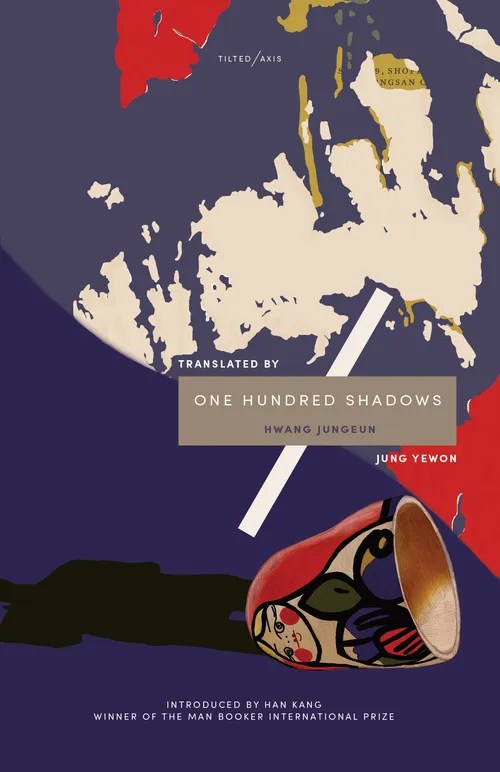
Sometimes we go in search of books. Other times, books find us. “One Hundred Shadows” by Hwang Jungeun, translated by Jung Yewon, found me.
This novella focuses on the relationship between Eungyo and Mujae, set against a gritty Seoul backdrop where the shadows of those living hand to mouth have started rising, beckoning their flesh counterparts to follow them deep into the unknown.
“Wiping the suds from my eyes, I thought to myself that even if my shadow had drawn me deep into the woods, so deep that I never returned, someone would still have stuck flyers on the door, and pizzas would still have been sold.”
The story walks a thin line between science fiction and fairy tale, making it a delightful read. It’s atmospheric and haunting, and often feels as if we’re looking at the characters through a hazy curtain. We watch them under a moth-covered streetlamp, stepping in and out of the light. We watch them through the dust motes in the air of the electronics companies in the run-down building they work in. We even watch them through the steam of the warm clam soup they share together.
Initially, it was very hard for me to figure out how old Eungyo and Mujae are. The book starts with them becoming lost in a dark wood and having to find their way out of it, like Hansel and Gretel. As the story progresses, however, we begin to see the backdrop of their lives come into focus, and it’s just as dark as the woods were.
The building where they work is scheduled for demolition, although all of the remaining tenants are uncertain whether to accept the terms being presented to them in compensation for up-ending their livelihoods. Meanwhile, people struggling like they are, be it with debt or family estrangement, are suddenly finding that their shadows are inexplicably rising away from their bodies, calling them to follow them into the unknown.
It’s hard to pin down this novella. Is it about the shadows? Is it about the relationship between the two main characters? Is it about the tragedy that sits behind the story, the catalyst for the story having been written in the first place? Can it be about all three, and then more?
In the author’s note, Jungeun states, “I spent every day protesting at the site of the incident, and at night, I would come back home to the novel in progress.”
That incident is the Yongsan District 4 Demolition Disaster. In 2009, 30 people, including residents of the Namildang building and members of the National Association of Evicted Residents, protested the building’s demolition and redevelopment by holding a sit-in on a temporary tower built on the building’s rooftop. Police and special riot police were deployed. On the morning of the 20th, between the protestors throwing Molotov cocktails and the police and special forces using water cannons and other weapons, a fire started on the temporary tower and spread quickly. Six people were killed (5 protestors and 1 police officer) and 23 were injured.
There had been no negotiations. The police had simply used brute force to wrestle the protesters off of the rooftop. There was little regard for the safety of both the protesters and the police officers, some of whom had been lifted up to the rooftop by crane.
“I wonder if they call this kind of place a slum, because if you called it someone’s home or their livelihood that would make things awkward when it comes to tearing it down.”
Initially, protesters were arrested and charged, but later had their records cleared by a presidential pardon. The police never made an official apology, as far as I can tell. The Human Rights Commission acknowledged that excessive force was used against the protesters during the incident. Changes were implemented to how the police handle such situations, but one has to wonder if enough was actually done.
Even without this background knowledge, the book is a beautifully written novella about the relationship between two lovers in a rather dim world. My only criticism is that sometimes the dialogue did not follow well, as the author didn’t use quotation marks. I had to read a few pieces of dialogue a few times to realize who was speaking, as it seemed as if a line or two was missing.
From the author’s note: “I decided to write through my feelings of helplessness, whatever book I ended up writing, because that was my job; and even better, I wanted to write something warm, something like a song. The novel, to my own surprise, evolved into a sort of love story. This is one of my most important themes: the resolve to hold on tightly to love, no matter the circumstances.”





 Koffee & Kpop
Leave a comment