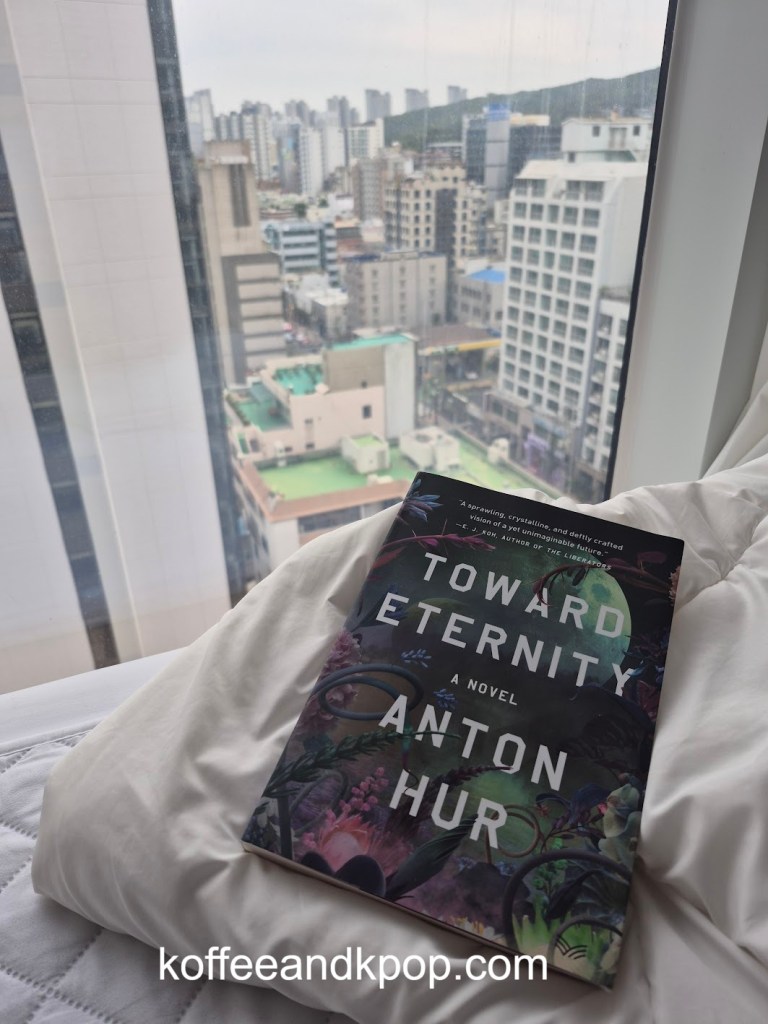
“Humanity is not a thing you achieve by giving. It is something that is given to you.” – Anton Hur, “Toward Eternity”
In The Near Future, we are introduced to Doctor Mali, who creates a notebook in order to chronicle the disappearance of Patient One, who has a nanodroid body but whose “redundant self,” or original body, has started to return, as shown through a scar that started to reform on his body.
After the reappearance of Patient One, Yonghun, Doctor Mali visits him in the hospital and he steals Mali’s notebook and thus, the storytelling is put into motion as the notebook passes between different hands for the rest of the novel.
Staring very early on, Hur uses his characters to muse about language and its inadequacy as well as its necessity. The novel references a lot of classic writings, referencing titles such as The Waste Land, Patient One having a PhD in nineteenth century poetry, and utilizing famous poetry from poets such as Christina Rosetti and Emily Dickinson.
I like smart authors—authors who very clearly know their stuff and trust the reader to understand what they’re taking on in the writing. Too often, books of today feel as if the author doesn’t trust the reader to understand aspects of craft, from foreshadowing to even basic plot.
Hur strikes the perfect balance here between plot and expatiation, leading to a fulfilling, yet intense, read.
Much of the novel is written from the perspective of Panit, a “computational heuristic utility for literary analysis” that was initially created to “identify the things readers and literary critics identify” until his creator, Yonghun himself, realized that Panit needed to “machine learn” from a human being, not simply read and process data that was input.
The book is divided into sections: The Near Future, The Future, The Distant Future, The Very Distant Future and Eternity–. The notebook we were introduced to at the beginning of the novel is the main vehicle for the storytelling and allows us to easily jump across eons without feeling disoriented.
I’m very sad that in today’s world, we as a society have started to deny people their very humanity in a myriad of ways. This book makes us confront what it means to be human, have memories, and how we create ourselves against the constraints of our world.



Leave a Reply