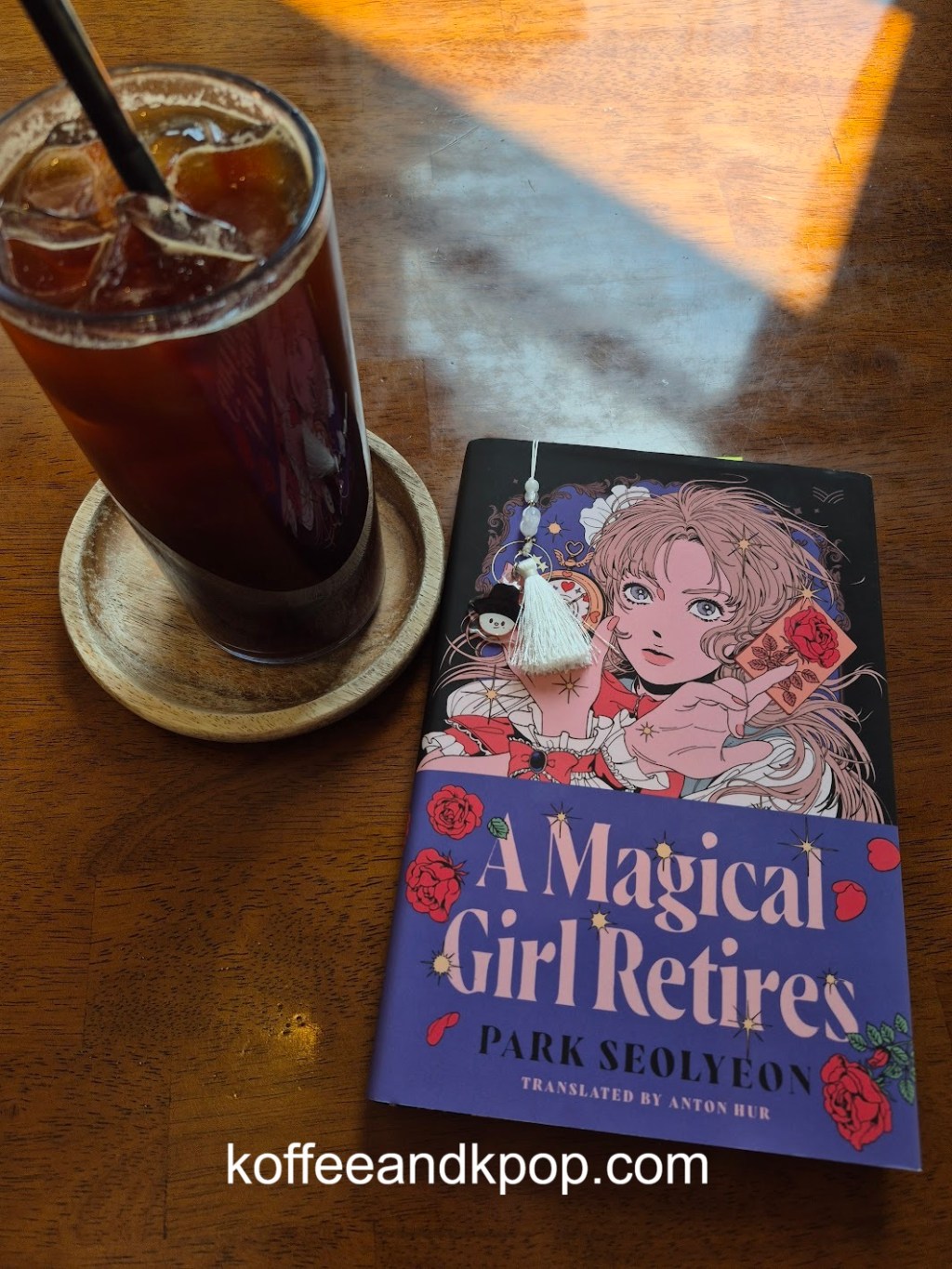
“Twenty-nine, depressed, and drowning in credit card debt after losing her job during the pandemic, a millennial woman decides to end her troubles by jumping off Seoul’s Mapo Bridge.
But her suicide attempt is interrupted by a girl dressed all in white—her guardian angel. Ah Roa is a clairvoyant magical girl on a mission to find the greatest magical girl of all time. And our protagonist just may be that special someone.” – from Goodreads
The magical girl (魔法少女, mahō shōjo) genre started in the 1960s with some manga titles and then, in the 1970s, anime appeared that led to the term majokko (魔女っ子), “little witch.” In the 1980s, that term became the “magical girl” that we know today.
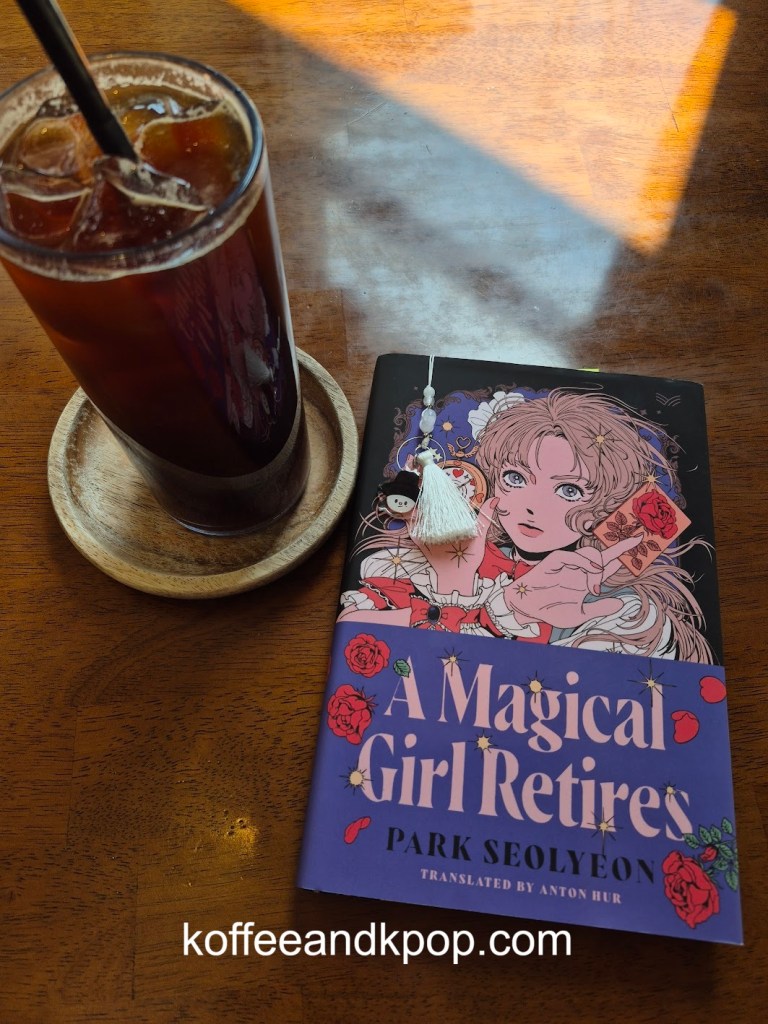
“A Magical Girl Retires” by Park Seolyeon, translated by Anton Hur, is a quick read with gorgeous cover art and sparse yet beautiful illustrations done by renowned artist Kim Sanho.
Park Seolyeon brings the magical girl genre head-first into some of the problems of the 21st century: credit card debt, domestic violence, poverty, and climate change.
Things I Enjoyed
Upon finishing this novella, I gave it 4 stars.
Among other things, I enjoyed the portrayal of poverty in the 21st century. Our protagonist goes to an interview wearing “the fancy, neat clothing” she had “washed and dried in the coin laundromat.”
“If I’d saved up the money I’d spent on the laundromat, I would’ve been able to afford a small used washing machine, but my apartment is so small there isn’t really a place to put one…”
This is a modern example of the “boots theory” which illustrates how someone living in poverty ends up spending more money in the long-term due to the inability to put down an initial investment. Sure, she could buy a washing machine, but her apartment is too small, in addition to the question of how she would wash her clothes in the meantime.
“It was embarrassing, to say the least, that my heart’s truest form was… a credit card. Way to tell the whole world that a corner of my mind is forever colonized by the thought of my credit card debt.”
Oh, how true this is for so many of us. It doesn’t even have to be credit card debt, specifically; our generation is ladled with all sorts of debts.
I also enjoyed the imagery of the bottle of water throughout the book. In the first chapter, she drinks some water from a bottle but feels “pathetic about how [she’d] come here to throw [herself] in the river yet was drinking water because [she] felt thirsty” so she throws the plastic bottle into the river. Half an hour later, she says, “Sorry for polluting the environment. I’m the real pollution. But then I started feeling thirsty again and regretted my decision. Why did I throw away my water? Maybe I was just born to regret everything.”
Later, a bottle of water is the first item she tries to buy with her magical black credit card, and it appears again at the end of the book. It is such an overlooked thing that many of use everyday, but its usage has further implications for our world.
It is not without its faults, however. Browsing the 1- and 2-star reviews on Goodreads, I found myself nodding along with a lot of the criticism but ultimately standing by my 4-star review.
Flaws of the Book
The two main flaws of the book are quite simple.
It is too short.
The book, at 160 pages, is a slim little novella that attempts to tackle big problems such as credit card debt, domestic violence, poverty, and climate change. While it sets the stage up nicely to accomplish this, it quite often doesn’t follow through—no real commentary is added to any of the big topics mentioned in the book.
As a reader, I wanted more. There are a lot of gaps between chapters where more information would have strengthened not only the plot, but the characters themselves.
For example, we never really got a sense of the protagonist’s backstory or her relationship with her Grandfather. Her relationship is obviously important to her but the author didn’t expound on it much at all.
As someone who lives in Korea and has become a fan of all the TikTok/Instagram reels from part-time convenience store workers (an official account can be found @cu_soonii), I wanted to see more of the protagonist’s life as a part-timer. She worked there like two days before the story just… moved on.
I also wanted to know more about the Magical Girls themselves, as well as their trade union. Only a few Magical Girls were really introduced in the book, and it would have been nice to have more backstory on them.
“‘It’s true most of the magical girls out there are girls,’ she said. ‘But not all magical girls are girls. You don’t have to look like a girl on the outside to become aware of your gift, and it’s not like we don’t age after we come into our calling.’”
I understand that what is being referred to here is when traditional “girlhood” ends–when you hit puberty? When you turn 18? Am I still a “girl” because I have plushies and keychains hanging off of my bags? However, when I read this dialogue, I had such a high hope for a trans Magical Girl. When she didn’t appear in the book, I was really disappointed. Maybe in the next one?
And now, onto the romance. It was so soft it was barely noticeable. When I say I would read a book about their relationship, I mean it. More sapphic romance, please!
The story is better suited to a graphic novel format.
One of the greatest strengths of this novella are the illustrations done by Kim Sanho. The cover is stunning, featuring a beautiful Magical Girl holding a compass and card emblazoned with a rose. The interior illustrations between chapters are just as beautiful, although done in black ink. I particularly love the one on page 88, which features the protagonist and Roa under an umbrella, the illustration focused on their eyes, gazing at each other.
Many people who gave the book a low review still complimented the illustration work, and that is why I believe that the story would have been more suited to a graphic novel. Since the magical girl genre started with Japanese manga in the 1960s, it seems fitting, then, that the book be imagined as a manga or anime. A collaboration between the author and the illustrator would have been fabulous, and it’d also be amazing as a webtoon or short animation. I wonder whether this avenue was considered at any point during the creation of the book.
Or perhaps the fact that it wasn’t written as a graphic novel was purposeful.
Ultimately, the storyline and illustrations are fabulous and I wanted more of both.
Conclusion
This novella is definitely worth the read. Were there flaws? Yes. Did I wish it were longer? Yes. But isn’t wishing there was more of something a positive thing?
I would encourage everyone who is interested to pick up a copy, as it is an enjoyable read.
The other day I was searching through my photos for the door of Drunken Jungle, a fabulous book bar in Seoul that I enjoyed and want to visit again. I was idly looking through photos I had taken of the bar when something caught my eye.
Is that…?
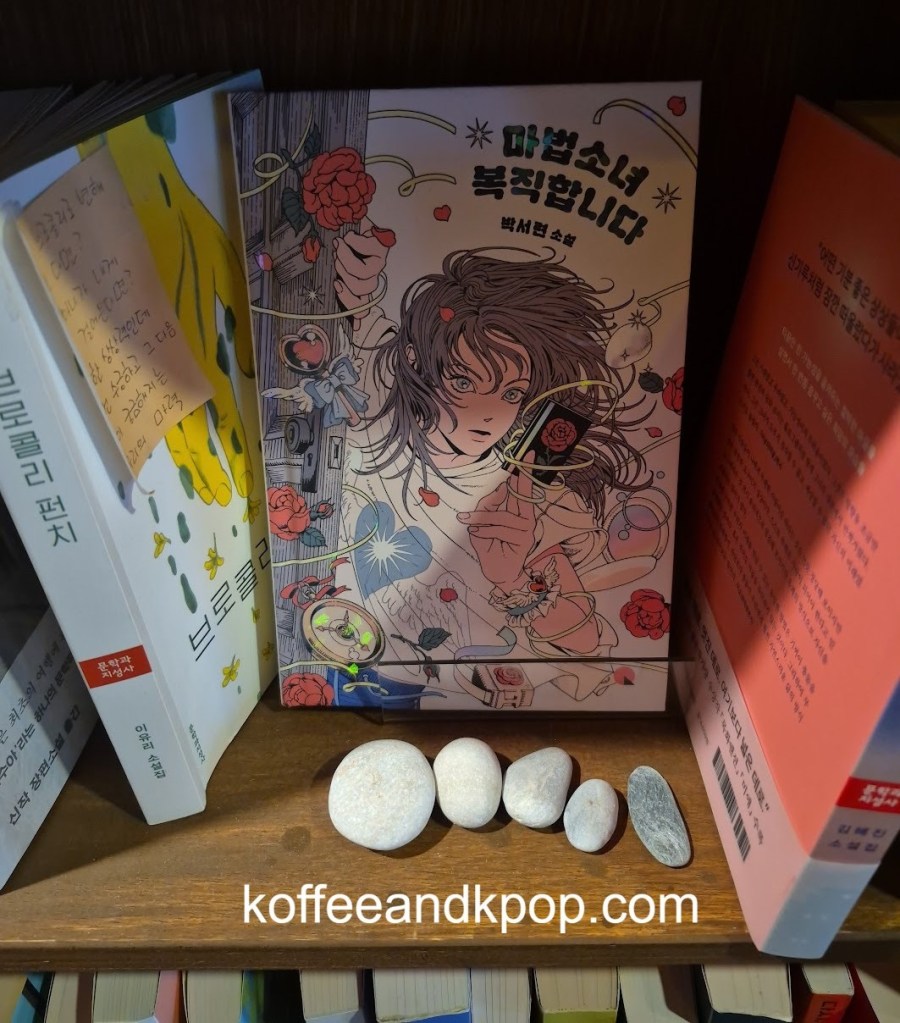
Yes, before I had even heard of “A Magical Girl Retires“, the Korean cover illustration of the sequel, “A Magical Girl Rehired“, had caught my attention.
I am, needless to say, very excited to get my hands on a copy of the sequel.
“This wasn’t a manhwa series; not every magical girl in existence could be good. Doling out love and hope, goodness, and so on; fighting against aliens or evil beings from another world; we were doing none of those things. We were just going through life, getting hurt in body and soul like everyone else. The only thing we had in common with those cartoons was that we couldn’t explain our powers in a scientific way; unfortunately, our world was infinitely messier, and here, anyone who fights a magical girl was going to get hurt. Someone was bound to bleed. And that someone might be a person not entirely unlike a magical girl themselves. But we had no choice but to fight…. the first battle a magical girl must fight is the fight to save herself.”


Leave a comment