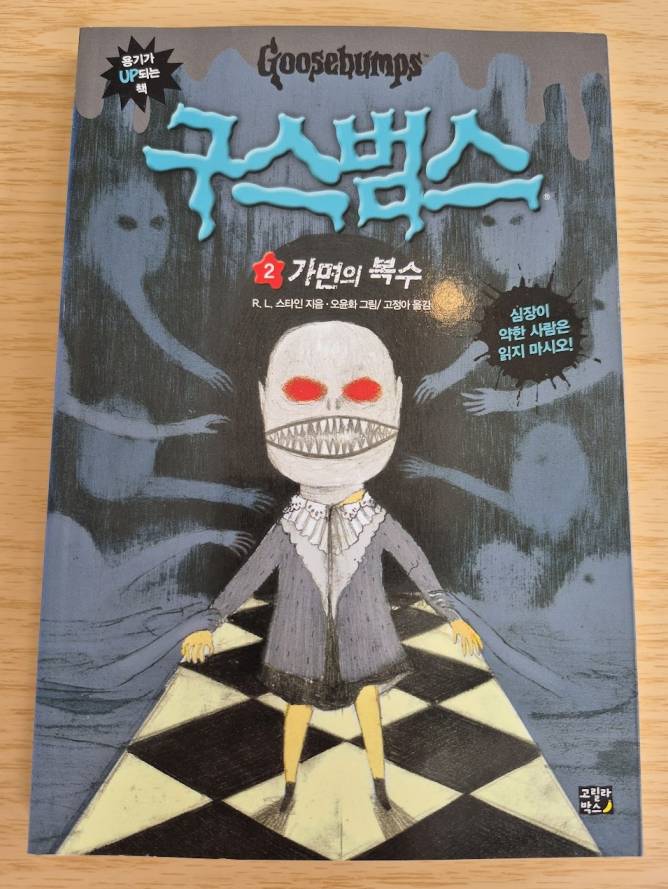
If you had told my ten-year-old self that, as an adult, she would have a Goosebumps collection in another language, she wouldn’t have believed you–and I have no idea what language she would have imagined that collection to be in.
I am forever indebted to a stranger in a distant city for facilitating the purchase and shipping of a collection of second-hand Goosebumps books.
Each Goosebumps book has a different translator and illustrator, although some translated and illustrated multiple books in the collection. Unlike the original Goosebumps books, the Korean collection features beautiful, often downright creepy interior illustrations. Even if I wasn’t using them to study Korean, they are valuable as collectibles.
I have done my best to track down the illustrator and post a link to somewhere where you can see more of their work. I have taken pictures of the cover art and one interior illustration from each book under the principle of Fair Use and for educational purposes.
My goal in sharing is to showcase the work of Korean illustrators whose work might not otherwise be seen by a global audience. The Goosebumps franchise had a huge impact on the childhood of many American millennials, and it is interesting to see how these books are interpreted, through illustrations, for an audience of 21st century Korean children.
Goosebumps #1: The Night of the Living Dummy (목각 인형의 웃음소리, “The Laughter of the Wooden Doll”)
written by R.L. Stine
translated by 노은정, Noh Eun-Jeong
illustrations by 소윤경, So Yun-Kyoung
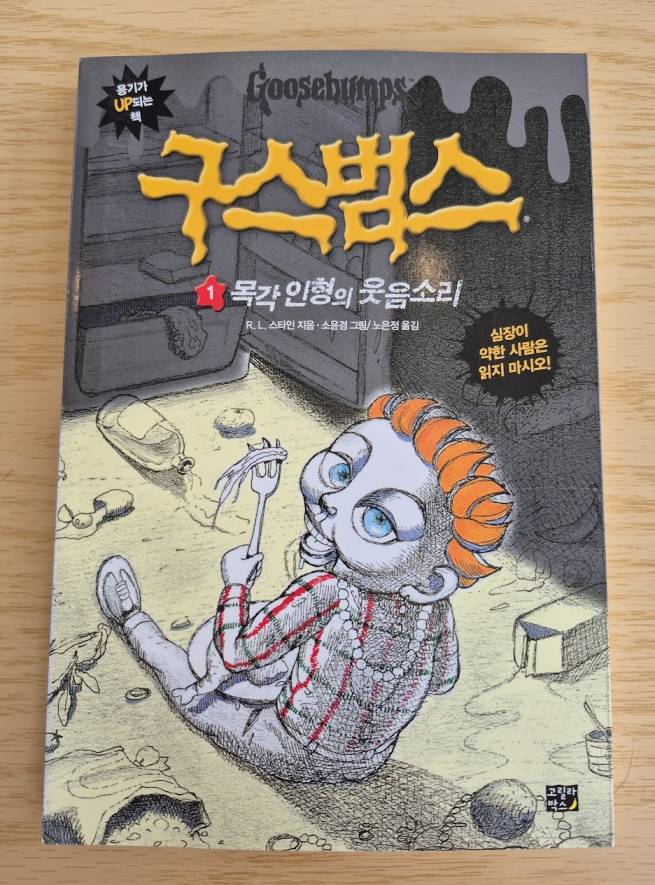
The first Goosebumps book to be translated into Korean is book number seven in the original franchise, “The Night of the Living Dummy.” It is “목각 인형의 웃음소리” (The Laughter of the Wooden Doll) in Korean.
Even though the Living Dummy books weren’t my favorite of the original 62-book series, I totally understand why they chose to publish this book’s translation first. Slappy is iconic and integral to the franchise’s success.
In Korean, he is not Slappy but 우디–“Woody”!
My favorite illustration in the book is the one depicting the two sisters, Lindy and Kris, set against a beautiful red patterned backdrop that is cut out in a dripping fashion. One of the sisters is smirking as she tells the other something, and the other has a frightened look on her face, as tears fall down her cheeks. It could be that the sister is simply frightening the other, but knowing that this is a Goosebumps book adds a level of spookiness to the illustration.
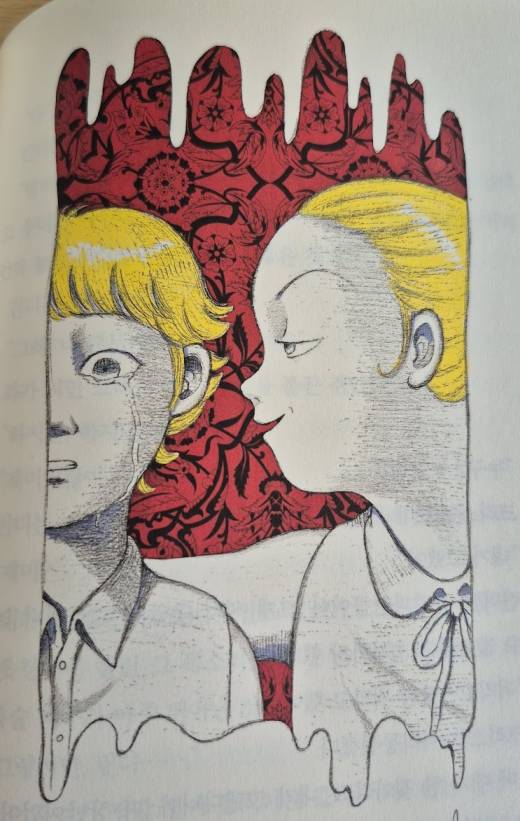
The illustrator, So Yun-Kyoung, has drawn and painted for many books across different genres and has more interior illustrations from the first Goosebumps book on her website:
https://www.sosee.kr/goosebumps
I haven’t found much information on the translator, Noh Eun-Jeong, but do know that they have translated a lot of children’s literature into Korean.
Goosebumps #2: The Haunted Mask (가면의 복수, “Revenge of the Mask”)
written by R.L. Stine
translated by 고정아, Ko Jeong-ah
illustrations by 오윤화, Oh Yun-Hwa
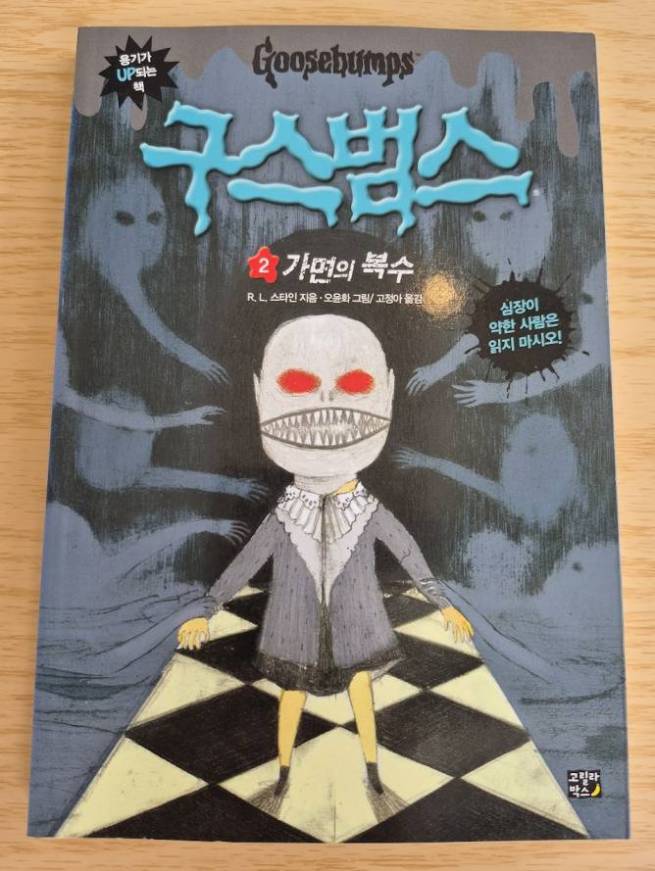
The second Goosebumps book to be translated into Korean is book number eleven in the original franchise, “The Haunted Mask.” It is “가면의 복수” (Revenge of the Mask) in Korean.
This is my favorite Goosebumps book, so maybe I’m biased but this was definitely worth being one of the first books translated into Korean.
Fun fact: “Carly Beth” is shortened to “Carly” (칼리) in the Korean version, as the “th” sound isn’t found in Korean. It’s often transliterated as an “s” sound, so she’d be “Carly Bess-suh” instead of “Carly Beth.”
All of the illustrations ramp up the creepiness of the story, and my favorite is the one where Carly is bent over, her head emanating a bright, blood-red light from wearing the mask.
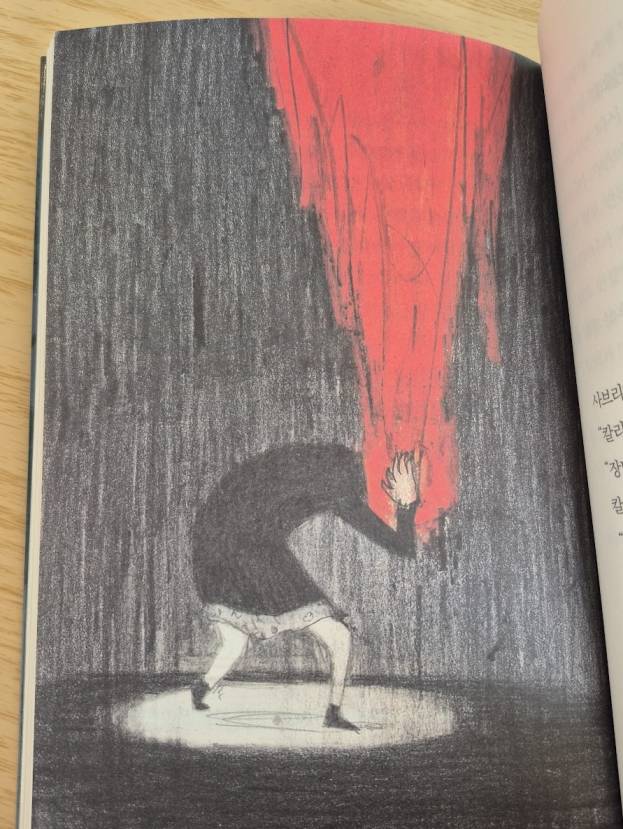
You can see some of the illustrator’s non-Goosebumps artwork on their Instagram page, which sadly hasn’t been updated in a while:
https://www.instagram.com/ohyunhwa_art
Like the translator for the first Goosebumps book, the translator for the second, Ko Jeong-ah, also translates children’s books into Korean.
Goosebumps #3: Welcome to Dead House (빈집의 숨바꼭질, “Hide-and-Seek in an Empty House”)
written by R.L. Stine
translated by 고정아, Ko Jeong-ah
illustrations by 조원희, Cho Won-hee
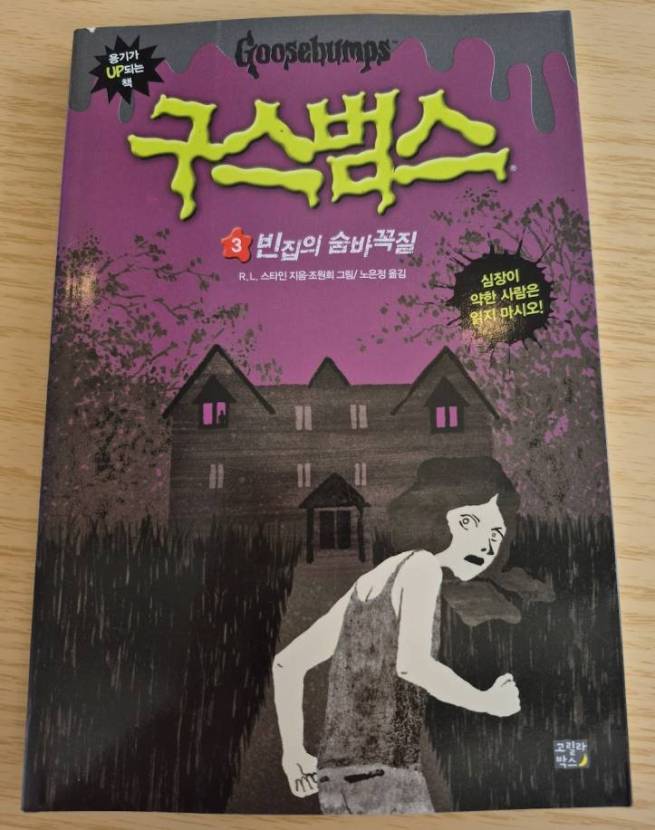
The third Goosebumps book to be translated into Korean is book number one in the original franchise, “Welcome to Dead House.” It is “빈집의 숨바꼭질” (Hide-and-Seek in an Empty House) in Korean.
I couldn’t figure out the English name of this book until I started looking through the illustrations and stumbled upon a spoiler near the end.
What I adore about the illustrations in this book are the illustrator’s usage of only three colors–black, white, and purple. There’s something very muted and beautiful about that that reflects the overall emotion of the book’s storyline, which is one of the few books in the franchise that features (spoiler, I guess?) the living dead.
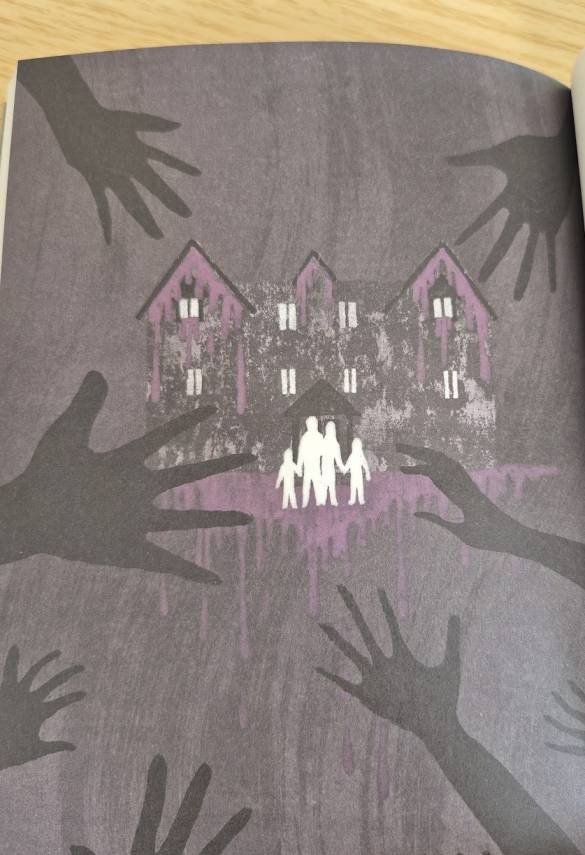
You can see more of their (more colorful) artwork on their Instagram page:
https://www.instagram.com/wonheeland
This the second Goosebumps book translated by Jo Keong-ah.
What was your favorite Goosebumps book growing up? Do you own any of your favorite books in more than one language?


Leave a Reply